

Congratulations On Your ADHD Diagnosis!
A welcome letter to our fastest growing membership

Dear Valued Patient,
Welcome. And congratulations.
You did it. You took the quiz. Seven questions, maybe nine. You answered them honestly, which is to say, you answered them the way anyone alive in 2026 would answer them.
Do you have trouble focusing on boring tasks?
Do you procrastinate?
Do you lose things?
Do you sometimes interrupt people?
You do. Of course you do. Everyone does. That’s the beauty of it.
The whole process took eight minutes. A telehealth provider you will never meet again reviewed your checklist, nodded at the screen, and confirmed what the internet already told you.
You have a brain difference. A neurodevelopmental condition.
We’ve streamlined everything.
You’re welcome.
First, Let’s Address Your Past
You may be wondering how this was missed for so long. How did you make it through school, hold jobs, raise children, file taxes, all while suffering from an untreated brain disorder?
The answer is simple: you were masking.
Everything you accomplished was accomplished despite your condition. Everything you failed at was because of it. We’ve designed the diagnosis this way on purpose. It explains everything and can be contradicted by nothing. Your successes are evidence of how hard you’ve had to work. Your failures are evidence of the disorder. Heads we win, tails you have ADHD.
That time you forgot your wife’s birthday? ADHD.
The project you didn’t finish at work? ADHD.
The texts you left on read for eleven days? ADHD.
Talking over your friend's story to tell a better one? ADHD.
The Amazon packages you don't remember ordering? ADHD.
Sleeping too much? ADHD
Sleeping too little? ADHD
The keys, the phone, the wallet, the appointment you missed, the conversation you tuned out of while scrolling? ADHD, ADHD, ADHD, ADHD, ADHD.
It was never a choice. It was never a habit. It was never the fact that you check your phone 144 times a day and have not experienced sixty seconds of unstimulated silence since 2011.
It was your brain.
You were born this way. Probably.
A Brief Note on Your Childhood
Some of you were placed in front of a glowing rectangle before you could walk. Your first word was buffering. Your lullabies were sung by an animated melon with forty billion views.
When you cried in a restaurant, no one picked you up. They picked up the iPad, propped it against the ketchup, and restored order to the table.
The stroller had a mount for it. The car seat had a mount for it. The high chair, the crib, the potty. Mounts everywhere. You were never more than eight inches from content.
You were soothed by tablets, raised by algorithms, and trained from infancy to expect a dopamine hit every 1.3 seconds. The videos were engineered by teams of neuroscientists to hold infant attention, a scene change every two seconds, colors calibrated in a lab, and they worked beautifully. You watched. You always watched. Your parents called it educational because the melon counted to ten.
You have never been bored.
Not once.
Not in a waiting room, not in a car, not in line, not at dinner, not in the ninety seconds it takes the microwave to finish. Boredom used to be where imagination lived. Where children invented games and stared at clouds and developed something called an inner life.
You wouldn’t know.
The moment discomfort arrived, the rectangle took it away.
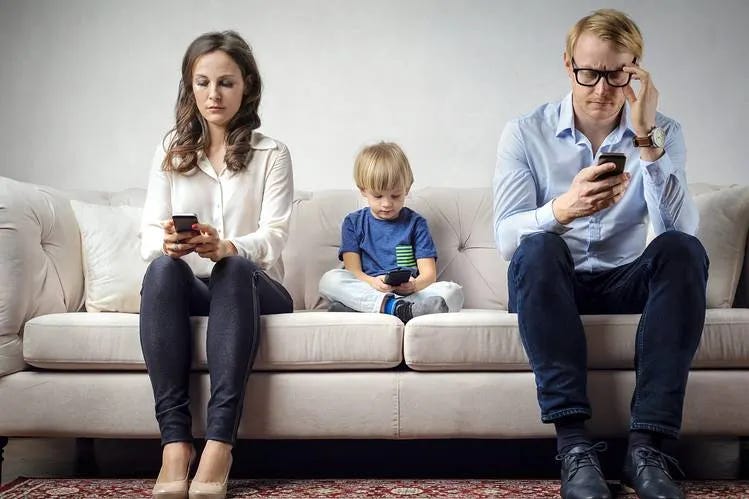
Your parents worried, briefly. The phone sent them a screen time report every Sunday. Eight plus hours a day. They glanced at it, felt a flicker of something, and swiped it away. Then they went back to scrolling in the same room as you, two screens glowing in the dark, together.
Now you find it difficult to read a book. To sit in a meeting. To listen to another human being complete a full sentence. You watch movies with subtitles on while playing a second video on your phone, and you call the second video “background.” Your attention has been bought, sold, sliced, and auctioned to advertisers since before you formed memories.
We have examined this situation carefully and concluded that you have a genetic brain disorder.
The science is settled. Please do not ask which gene. Please do not ask why the disorder’s prevalence tracks the iPhone release schedule. Please do not ask anything at all.
Curiosity that persists is a symptom.
What You’ve Gained
As our newest member, you now have access to:
1. A lifelong identity, conveniently abbreviated to four letters
2. Legal amphetamines, delivered monthly, no refills wasted
3. A prescription chemically adjacent to methamphetamine, which is fine, because yours comes from a pharmacy and has a friendly name
4. An explanation for every shortcoming, past, present, and future
5. A community of millions who will affirm that nothing is your responsibility
6. Permission to begin every sentence with “Sorry, my ADHD”
Frequently Asked Questions
How do I know my diagnosis is real? It’s in your chart. Charts are real.
But how was it validated? You completed a self-report checklist describing universal human experiences. A provider agreed with you. This is what we call clinical rigor.
What if my problems are actually my phone? Interesting theory. Have you considered taking the phone into the bathroom with you while you think about it?
Will I need the drugs forever? We prefer the term “long-term management.” The good news is that when the prescription stops, your focus will be worse than before you started. This proves you needed it all along.
My eight-year-old got diagnosed too. Is that normal? It’s better than normal. It’s growth. He was the youngest in his class, which research shows dramatically increases diagnosis rates, but we don’t like to talk about that. Immaturity used to resolve with maturity. Now it resolves with Adderall. Progress.
I’ve noticed the drug doesn’t work like it used to. What’s happening? Nothing is happening. Your dose is simply ready to grow. Think of it as a promotion. When a street user needs more of the same chemical to get the same effect, we call it tolerance. When you need more, we call it titration. The words are doing important work here. Let them.
I feel like I can’t function without it anymore. Is that dependence? What an ugly word. No. Dependence is what happens with drugs. This is medicine, and what you’re describing is your underlying condition revealing its true severity. You were always this impaired. The drug was simply hiding it from you. Funny how the impairment grew to match the prescription, isn’t it? Don’t answer that.
I tried to take a break and I couldn’t get off the couch for a week. I felt flat, exhausted, dead inside. Yes. That’s the ADHD. We understand it doesn’t resemble your original ADHD, which was losing your keys, but the disorder is flexible. Whatever you feel when the drug leaves your body, that’s the disease, and it means the drug must come back. We realize this is also exactly what a dependent brain does when deprived of its substance. The overlap is one hundred percent. We’ve decided not to find this interesting.
So what should I do when this happens? Increase the dose. Add a second drug for the crash. Add a third for the sleep the second one took. Whatever you do, do not slowly come off and discover that your baseline returns, your sleep deepens, and your keys were never the problem. Patients who do this stop being patients, and then who would we even be to each other?
Can I diagnose myself on TikTok first and get it confirmed later? That is now the standard pathway, yes.
Share Your Journey
This is the most important part.
ADHD is not just a diagnosis. It’s a brand. A personality.
Please include it in your social media profiles. Make it your pinned post. Film yourself losing your keys and caption it “the ADHD experience” and watch the likes pour in from four million people who also lose their keys, because everyone loses their keys, because keys are small.
You’ll find the community immediately. They’re easy to spot.
They cannot finish a task, but they produce daily video content about being unable to finish a task. Consider what that involves. Scripting. Filming. Cutting between angles. Color grading. Captions timed to the beat. Posting on schedule, every day, for years. An attention disorder, documented with the sustained executive function of a small production studio.
The same person who cannot endure a ten-minute meeting will play a video game for nine hours straight, tracking inventory, managing resources, and coordinating a raid with eleven strangers across three time zones. They will not eat. They will not look up. On the surface, it looks like focus that appears only when the task is interesting.
Do not be confused.
This is called hyperfocus, and it is also a symptom. The inability to focus is a symptom. The ability to focus too well is a symptom. We have the middle covered too. You may be wondering what would not be a symptom. Stop wondering. You know what wondering is..
And remember: if anyone suggests your difficulties might involve sleep, screens, stress, diet, boredom, an unlived life, or the simple fact that modern existence is engineered to defeat undivided attention, that person is dangerously ignorant. Anti-psychiatry. Anti-science. They are invalidating your condition, and invalidation is violence now.
Block them. If they’re a friend, end the friendship. If they’re family, go no-contact and post about your boundaries. And if they’re a medical or mental health professional, report them to their licensing board immediately. A clinician who asks about your sleep before reaching for the prescription pad is a danger to the community. At minimum, find them online and leave a scathing Google review. One star. “Did not listen.”
The irony is free.
Remember: you have a medical condition. You took a quiz.
Welcome to the club. Membership is growing every day. At current rates, the disordered will soon outnumber the normal, at which point we’ll need a new diagnosis for the people who can still pay attention.
We’re working on it.
Warmly,
The Psychiatric Industrial Complex
AWAKEN
I try to keep RADICALLY GENUINE as free as I can, but it takes quite a lot of work. Your support provides me the courage to write what needs to be written, not what’s safe or acceptable. Thank you for believing in this work and making it possible for me to dedicate real time to these revelations.
For some of us, we didn’t park the kids in front of TV’s nor hand them glowing rectangles and STILL this BS diagnosis came down—why? Because it is a very convenient way to deflect meaningful conversations that might be had around education reform and its utter lack of inspiration from both an environment standpoint meaning the actual classrooms squashing any impetus to feel engaged and the curriculums that offer students zero real-world application incentive; that offer no reward to wonder about or imagine deeply into Anything presented as being required to learn.
And this cautionary tale can apply to multiple rackets across the board of the global hegemonic mafia shell game. Luckily the Apocalypso is here so Dance!!!🕺