

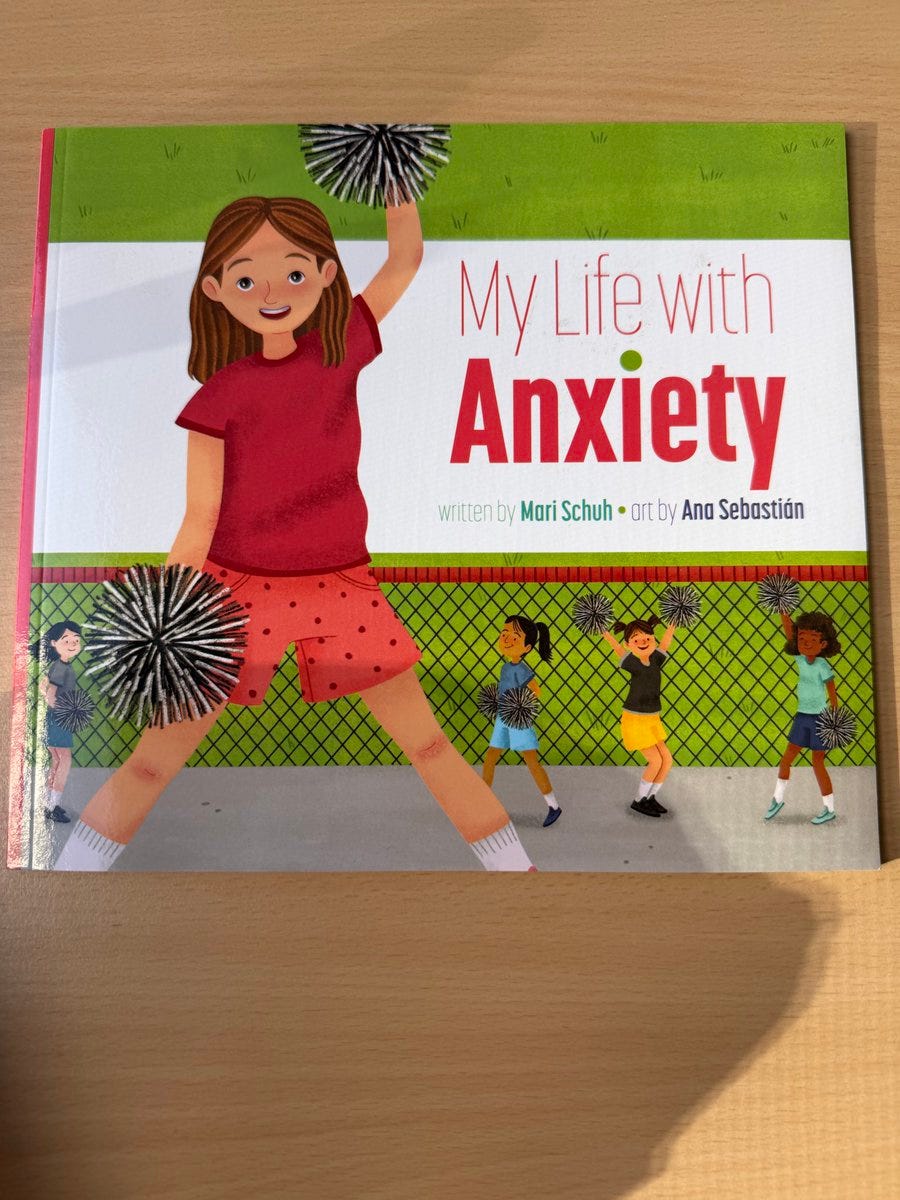
There is a picture book on library shelves right now called My Life with Anxiety, written for seven-year-olds, with a smiling girl in a red shirt shaking her pom-poms on the cover. This book sits in elementary school classrooms throughout the United States.
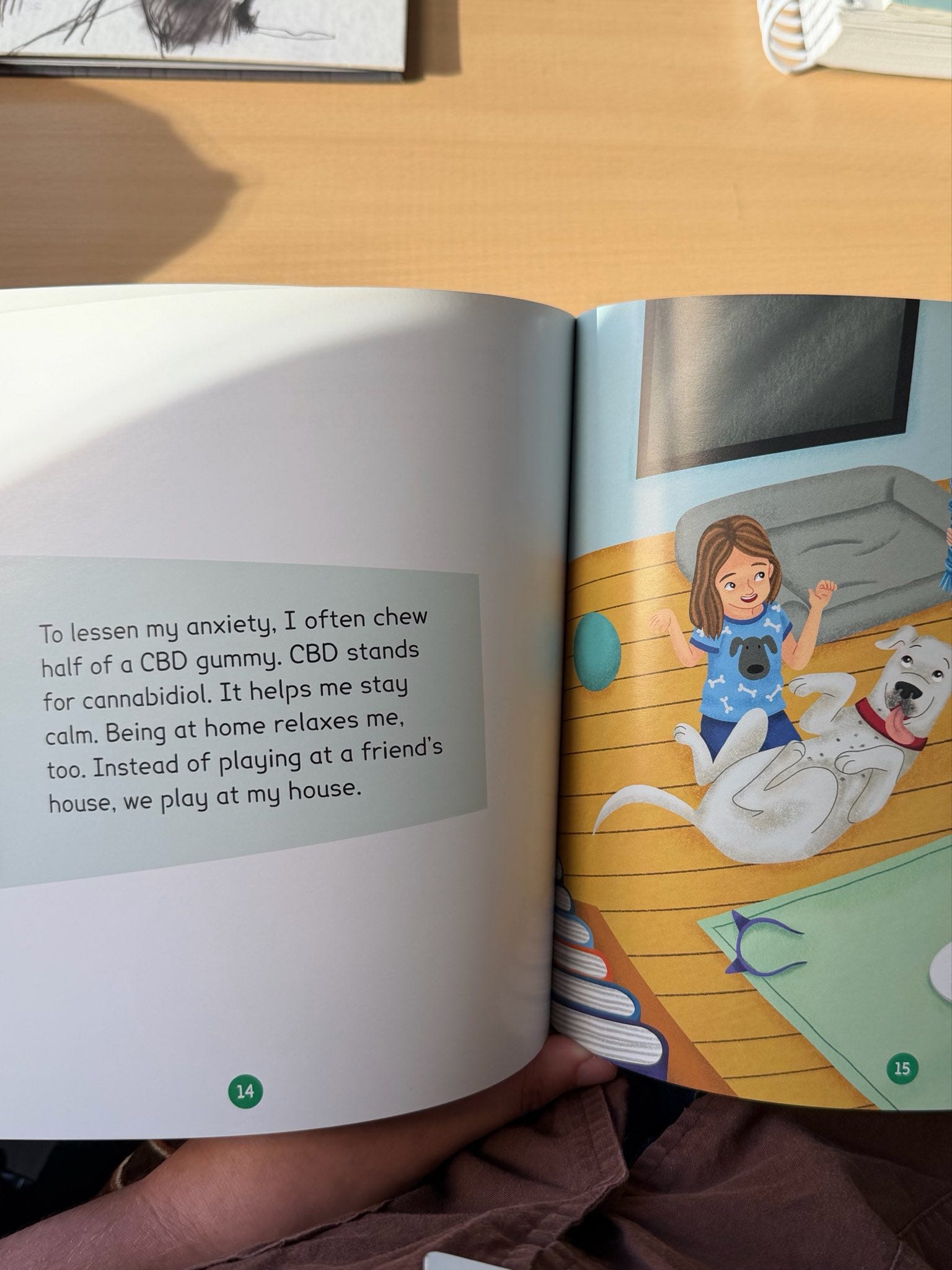
Turn to page fourteen and you find out how she copes with being alive: she chews half of a CBD gummy, and when her friends want to play, they come to her house instead of the other way around, because home is where she feels calm.
I want to be clear about who this piece is aimed at before I go any further. The girl in this book is a real child, and she is not my target. The adults are. An author, an illustrator, an editor, a publisher, an elementary school teacher, every librarian who filed this book under children’s nonfiction read that page and decided it was a lesson worth passing on to second graders.
This little girl did not catch anxiety, however desperately this book wants you to believe it's a disease. The adults around her caught an ideology, one that feeds on our empathy and hands us back a lie: that to love a child is to spare her every discomfort. That isn't love. It's surrender.
Once you accept that a nervous stomach before cheer practice is a condition that calls for a gummy, there's no logical place to stop, so let's follow the idea where it leads.
My Life with Butterflies could follow Jayden, who feels a fluttering in his stomach before the spelling bee and learns that, unlike the neurotypical kids in his class, he is better off staying home on spelling bee days, which his teacher assures him is very brave.
My Life with Boredom could introduce Tyler, who discovers that boredom is not something he feels on rainy Sundays but something he has, and who takes his Adderall so he can focus on the book his parents want him to read.
My Life with Grief could tell the story of Emma, who felt sad for a long time after her grandmother died until the grown-ups helped her understand that sadness is a condition, and that there are ways to make sure she never has to feel it (insert Prozac advertisement).
It would all be funny if the first book in the series weren’t sitting on a shelf right now.
In the span of a single page, a child learns that anxiety is dangerous, that it lives inside her as a condition setting her apart from other kids, and that like a peanut allergy it has to be managed for the rest of her life. She learns that the way to manage it is to avoid whatever makes her nervous and to find relief in something she puts in her mouth. Every one of those lessons is false, and the book presents each of them to a seven-year-old as simple fact.
Consider the word the publisher chose to describe this little girl. We are told she does some things differently than “neurotypical” people, as if the stomach that flutters before cheer tryouts belonged to some rare and fragile category of human being. It is the most typical nervous system there is, and the child who felt nothing before stepping in front of a crowd would be the unusual one.
Anxiety is the body preparing for something that matters. It is the same energy that sharpens an athlete before a game and steadies a performer before the curtain rises, and every person who has ever done something brave did it while feeling exactly what this book teaches children to treat.
The avoidance deserves its own attention, because anyone with common sense knows that steering around what you fear is the most reliable way to make the fear grow. Each avoided sleepover teaches a child a little more convincingly that the world is dangerous and that she is not equipped to handle it, so her fear gets bigger while her life gets smaller, and the adults around her call this a disorder.
Then there is the gummy, and the real danger isn't what's in it but what it teaches. A seven-year-old learns that when something stirs inside her, she should swallow something to make it go quiet, before she ever discovers she could have simply felt it and survived. Today it's half a gummy. Tomorrow it's a pill, then a drink, then a prescription, because the habit outlasts the candy. This book isn't teaching her to cope. It's teaching her to numb.
A child raised on it learns to fear fear itself, to monitor her own heartbeat for signs of trouble, and to treat every flutter of nerves as a flare-up of something wrong with her. Most of all, she learns that the answer to her inner life will always come from outside of her, whether that turns out to be a gummy at seven, a diagnosis at ten, or a prescription by fourteen.
Books like this do not protect children. They teach them to surrender the most important capacity a human being has, which is the ability to feel something hard, stay with it, and come out the other side stronger for it. A generation that comes to believe its own feelings are a disease will spend a lifetime needing someone to sell it the cure, and people who depend on someone else to sell them relief from being human are not free. Make no mistake about what is happening here.
We are under attack, and what is being attacked is the very experience of being human.
Every movement to protect what matters starts with someone willing to sound the alarm. Paul Revere did not stop an army on his own. What mattered that night was that he saw the danger coming and refused to keep it to himself. If this piece opened your eyes, don't let it end here. Share it with the parents in your life, the teachers you trust, and anyone who still believes children are strong enough to feel something uncomfortable and grow from it. The alarm only works if it spreads.
AWAKEN
On October 1st, the Radically Genuine Podcast enters a new era: an in-person studio, a new home built for this mission, and my new co-host, Tracy Thurman, whose calling has run parallel to mine in ways neither of us can dismiss as coincidence. Together we are expanding far beyond the mental health industrial complex into the full terrain: spiritual awakening, health and medical freedom, consciousness science, and the hidden knowledge this series has begun to unveil. Long-form conversations, short films, documentaries, and a community for those ready to go deeper. Everything you are reading here becomes the foundation for what we build there. If you feel called to this work, you are already part of it. More soon.
This is teaching children to be weak, to run from life, to expect the world to accomodate their fear. Everything i spend my work days trying to reverse in adults.
I will never forget the school counsellor at my sons primary school sending an email to all the parents saying that her daughter was upset she didn't get a medal at the athletics carnival, so she made one for her, and other patents could do the same.
The disease here is toxic empathy, cowardice and self pity dessed up as compassion. They disable children and call it love. It is very similar to Munchausen by proxy, adults faking or causing sickness in children to get attention and status.
In the UK, we have 'All Dogs have ADHD', which assures us that ADHD "may be detected soon after birth". Then there is 'All Cats are on the Autism Spectrum', which gives us the stunning insight "those on the spectrum look at the world in their own unique way" and 'All Birds have Anxiety', which declares that "many people have anxiety and it often runs in families...".
I notice that since I first wrote about these books, there are now two new volumes 'All about PDA' (Persistent Demand Avoidance) – because professionals want us all to know that PDAers are "amazing people who help us reevaluate our philosophies and approaches to life", and illustrated with a squirrel, plus 'All About Dyspraxia' with a giraffe on the front, full of "gorgeously awkward imagery"...
I cannot begin to tell you how much I loathe all of this. It addresses difficulties in entirely the opposite way from which I have always worked with children and young people.