


About ten days ago, without warning, dread rolled in and enveloped me. I suspect most people reading this know the feeling.
It was an ordinary morning. Beautiful weather, nothing out of place, and I was moving through my usual routine when this overwhelming feeling arrived. I do not mean a mood. It was closer to an atmospheric change, an overwhelming sense of darkness that came fully formed and settled over the day the way a storm settles over an open field.
No news had come. Nothing in my life had shifted. There was no prompting event of any kind that a reasonable person could have pointed to, and yet the sunny day had become a storm.
What happened next is the part worth evaluating, because my mind went straight to work manufacturing a case. It began scanning my life for something to pin the feeling on, searching through relationships and obligations and unfinished business for anything that might justify what I was experiencing. The overwhelming emotion arrived first and uncaused, and then the mind produced explanations after the fact and handed them to me as a series of possibilities.
It lasted about a week. I am almost embarrassed to admit that, and more embarrassed to admit that I acted in ways during that week that made things harder than they needed to be. We have this tendency, at times, to make a bad situation worse.
Nothing that damaged what matters most to me, but I was not at my best and I was not connected in the way I am usually connected, and I created distance where there did not need to be any.
We are told there are three explanations available for an extended episode like that one. The first suggests some prompting event, the idea that something happened and your emotion is a valid signal in response to it, which I have spent most of my career teaching because it is frequently true. In fact, I would argue that many therapists assume this to be the case most of the time and work with people to understand their emotions in response to something in their life.
This could be a huge mistake if the assumption is incorrect, because the therapist and the client could be manufacturing a problem that does not exist. This is one concern I have with therapy culture.
The second explanation is the mind. Our minds have the ability to travel into the past and fixate on old mistakes, or run ahead into the future and manufacture worries that do not yet exist. We are prone to self-judgment and to misreading what is in front of us, and we attach to an inner world capable of generating the full range of human emotion. There are psychological theories holding that unconscious processes drive what we feel and do, that our childhoods and our histories act on us in ways we never become aware of. Simply, we are creating pain from our minds and nothing in the moment is of grave concern.
All of this is potentially true. But in my case the emotional experience came first and the mind acted second to come up with reasons.
The third explanation is always biological, and in today’s environment emotional experience is increasingly attributed to biological causes we cannot see. Exposure to toxins. Diet and lifestyle. Genetics, inflammation, a chemical imbalance, or some physical mechanism operating below the threshold of awareness. For many women, it is assumed to be premenstrual or hormonal. It’s my belief we over rely on these explanations without sufficient evidence.
To my knowledge, none of the three fit for me. There was no event to react to, nothing in my thinking that would originally account for it, and I was healthy and rested and living well. So my mind did what a mind does when it finds itself overwhelmed by an emotion without any know cause. It went looking for a reason, and then it went looking for a problem to solve, and in the searching it made everything considerably worse.
A few days later I learned what had been unfolding in my social circle while I stood in my kitchen feeling something I could not explain. Real situations, meaningful ones, involving people I care about. I had no awareness of any of it at the time, and none of it was happening anywhere near me. It was occurring hundreds of miles away.
Could I have been picking up on that energy from hundreds of miles away? Do we have the ability to tap into future timelines?
These are important questions to ask and to explore scientifically. But almost nobody does.
There is a word that gets deployed the moment anyone in a professional setting raises this territory, and everyone knows what it does.
You become woo.
You become unscientific.
Spiritual.
Now, the disciplined thing to do here is not to declare that human beings have access to information outside their physical proximity, that we pick things up energetically, that there is some sixth sense available to us. The disciplined thing to do is to consider the possibility and explore how or why this may be true.
In twenty plus years of clinical work, a pattern emerged that I could not deny. The most sensitive people I met, the most attuned, the ones who seemed to register what was happening in a room before anyone said a word, were consistently the ones carrying psychiatric diagnoses, sent to therapy and placed on drugs. They were artists and creatives. They were nurturing, loving, generous people who felt things at a depth that most of us never experience. The word we reach for is sensitive.
But sensitive to what?
They struggled to tolerate crowds and large groups of people. They struggled in environments thick with conflict and competition and emotional distance, the kind of environments where other people are emotionally detached and even thrive. Since they appear unaffected, they assumed something must be wrong with them.
They seemed to absorb the emotional experience of everyone around them and could not tell you why. Eventually somebody told them this was a disorder of emotional regulation, and they believed it, because a professional said so.
Notice what that assumes. It assumes we already know what is in the room and that they are responding to the wrong amount of it. It never occurs to us that they might be responding to the right amount of something we cannot detect. A person who is attuned to a frequency outside the typical range may be demonstrating a gift. A person who experiences something your eyes cannot process may be tapped into more of reality.
What if they were picking up on a field? What if some portion of what arrives inside a person did not originate inside that person at all?
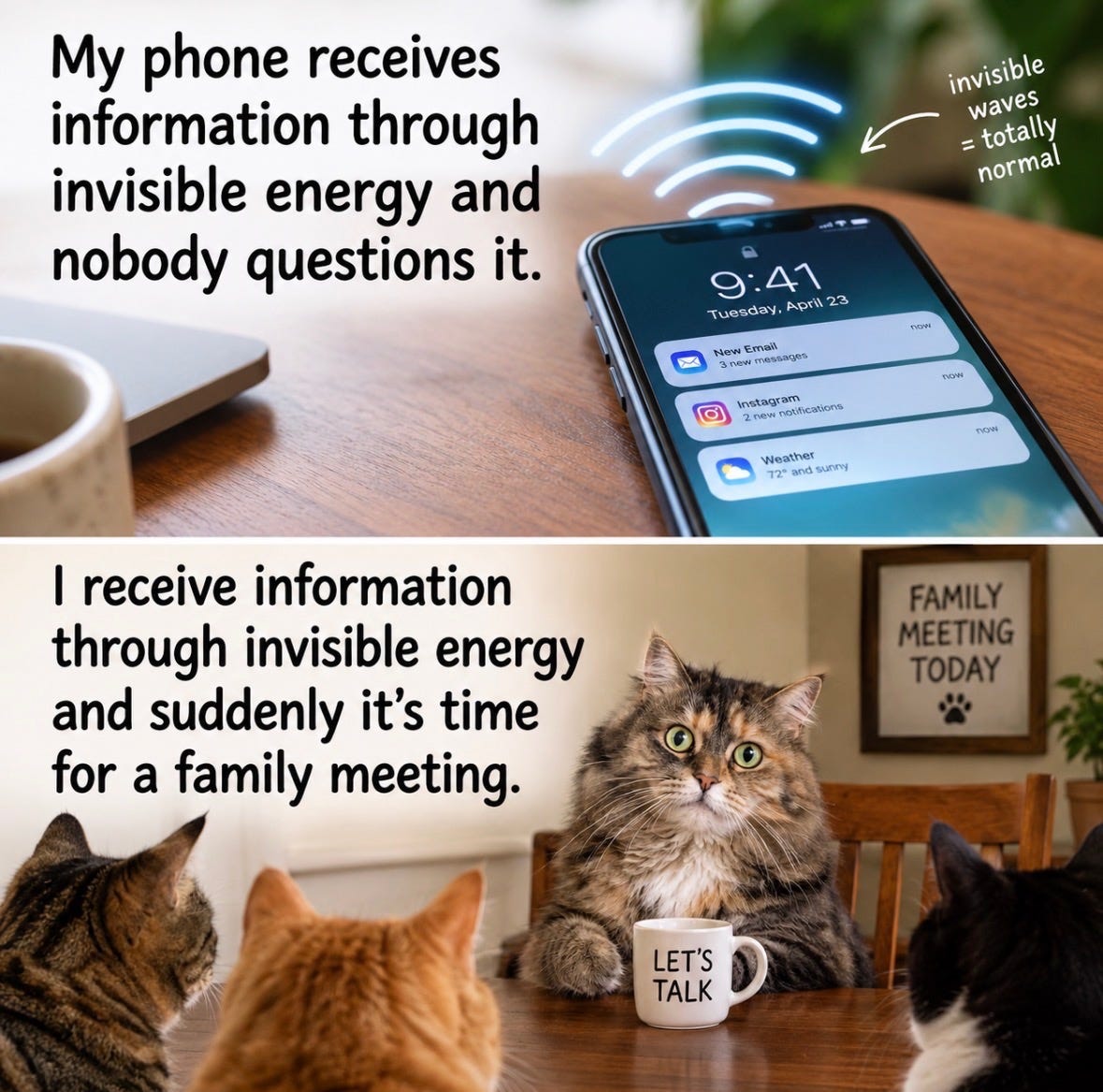
This should not be difficult to entertain, because we already live inside the answer. Right now, information is moving through the room you are sitting in. A voice is crossing an ocean and reassembling itself in someone’s ear. Images are traveling as waves through walls and arriving as a picture on a screen. Your phone is receiving instructions from a satellite in orbit. None of this is visible, none of it is audible, and none of it requires physical contact with anything.
And if information moves as energy, then the question is not whether human beings are affected by waves. We know they are. The question is which ones, and how far the reception extends, and whether the thoughts and emotions of other people are among the things arriving.
These are scientific questions, and they are already being asked in laboratories by serious people. The findings are not conclusive, but they are strange enough that a curious field would be chasing them rather than avoiding them.
Start with time, because that is where the results are most difficult to explain away. A 2012 meta-analysis published in Frontiers in Psychology pooled twenty-six studies from seven independent laboratories and found that human physiology appears to shift one to ten seconds before an unpredictable event occurs. Skin conductance and heart rate begin responding to an image the person has not seen, chosen by a random generator that has not yet fired. The finding was re-examined and updated in 2018 and held. The physical reaction comes first, which means whatever is doing the knowing is not the conscious mind, and whatever is being known has not yet happened. Researchers call this predictive anticipatory activity. Everyone outside the laboratory calls it a gut feeling.
Consider an experiment published in Neuroscience Letters in 2003. Researchers placed pairs of people in separate rooms, each shielded against both sound and electromagnetic signal, recording EEG from both at the same time. One person was shown a flashing visual pattern designed to produce a measurable brain response. The other sat quietly with no stimulation at all and no way of knowing when the flashes were occurring.
The brains of the unstimulated subjects showed corresponding activity, appearing at the moment their partner was being stimulated, and the authors were direct about what they had found, noting that correlations between the brain activity of two separated people may occur even though no biophysical mechanism is known to account for it. Two shielded rooms, no signal that physics currently recognizes could cross between them, and one nervous system responding to what was happening to another.
In plain terms, something happened to one person and a second person’s body registered it from another room, through walls built to block every form of transmission we know about. Nothing to see, nothing to hear, no way to guess, and the body responded anyway. If we continue to replicate this, the separation we take for granted may be an illusion.
For roughly two decades beginning in 1972, the United States government funded research into whether human beings could perceive information at a distance. The program ran under several names before settling on Stargate, cost around twenty million dollars, and was carried out at Stanford Research Institute and later SAIC under the sponsorship of the CIA and the Defense Intelligence Agency.
Declassified records show remote viewers were tasked against real intelligence targets, including hostage locations during the Iran crisis, drug trafficking operations, and Soviet military sites. When the American Institutes for Research evaluated the program in 1995, the statistician brought in to assess the data was Jessica Utts, who concluded that the statistical evidence was stronger than that for many findings the sciences accept without argument, and that the useful question was no longer whether the phenomenon existed but how it worked. Utts went on to become president of the American Statistical Association.
A parallel body of work is developing around what researchers call the biofield, the interacting fields of energy and information associated with living systems. In 2015, Global Advances in Health and Medicine devoted an entire supplement to biofield science and healing, assembling researchers from medicine, physics and psychology around the question of whether these fields can be measured and whether working with them changes clinical outcomes. A 2025 review catalogued the research across hundreds of studies in pain, cancer care and general wellbeing. The field is young and its methods are still being built. But it exists, it is peer reviewed, and it is being conducted by people at institutions you have heard of.
And then there is what physics itself has established. The 2022 Nobel Prize in Physics went to Alain Aspect, John Clauser and Anton Zeilinger for experiments with entangled photons demonstrating the violation of Bell inequalities. In plain language, they showed that two particles can be linked in such a way that what happens to one is correlated with what happens to the other, across any distance, with no signal passing between them and no hidden local mechanism capable of explaining it. Separation at the most fundamental level of physical reality is not what it appears to be, and this is not speculation or fringe science.
The Illusion of Separation
I do not believe we are separate in the way our physical reality presents itself to us. The separation is real enough as an experience. You are over there and I am over here, and there is space between us that takes time to cross.
I believe in the interconnectedness of all of nature. Every biological process on this planet is connected to every other one. Remove one organism from a forest and the effects propagate outward in directions no one predicted, because the forest was never a collection of separate things but a large connected organism.
Why would human beings be the exception?
If we are more connected than we recognize, then the human capacity to feel another's energy across distance is not fantasy. It is the next truth coming into view. We are the generation standing at the edge of it, still reaching for the vocabulary of separation to describe experiences that are already telling us otherwise.
I think about those “Sensitive” souls constantly now. The ones I sat with, who told me they felt things they could not explain and were informed that this was a symptom of a mental illness. I remain concerned that they are being taught to disconnect from their capacities to feel. I am concerned they are being pharmaceutically disconnected from their gifts.
We are standing on the precipice of a different understanding of the human experience, and I do not think that is an overstatement. The model we inherited begins from separation and it ends in fear. If you are separate, then what you feel belongs only to you and suggests your reaction is the problem. The chemical imbalance story arises from this premise.
The other model begins from connection, and everything follows differently. Emotion is an “energy in motion” and provides us an important signal. Even if we do not yet understand what the signal is trying to inform us. Sensitivity becomes an attunement to energy rather than a personal defect. Health becomes a question of alignment with a larger order rather than the absence symptoms.
So I would pay close attention to who benefits from the first model. I would be wary of any person, institution, government or scientific body whose central message is danger, division and separation, and I would be more wary still of the ones who follow that message with a product.
Consider what we have been sold.
Chemicals engineered to kill, spread across the food supply and the soil and the water, sold to us as progress. Pesticide. Herbicide. Fungicide. Every one of those words ends in the Latin for killing, and we apply them to the living systems we are made from and then wonder why we are sick. And alongside the chemistry, a technology industry promising to upgrade the human being, as though we were unfinished equipment awaiting a better version of ourselves.
Watch for the ones who divide before they explain. Watch for the ones who provoke fear and then arrive with the solution. Watch for the ones who treat a human being as an isolated mechanism to be adjusted rather than a living part of everything around it. That framing is not neutral and it never has been. A person convinced of their own separateness is frightened, and a frightened person will accept almost anything.
And the pattern is not difficult to trace. The more disconnected we become, the more drugged we become. The more drugged we become, the sicker we become. We have run this experiment for generations now, at enormous scale, and the results are visible in every clinic and every classroom and every family in this country. Whatever we are doing, it is not producing healthy people.
Is it possible that I picked up on something that morning, and that others do too, and that a field of interconnectedness explains our thoughts and emotions better than anything I was taught?
I am not asking you to believe it. I am asking why we would agree to stop looking. A question does not become dangerous because the answer might be inconvenient for the people who profit from the current one.
These are the conversations I am now having on the new Radically Genuine Podcast. I can’t wait to launch on October 1st
AWAKEN
On October 1st, the Radically Genuine Podcast enters a new era: an in-person studio, a new home built for this mission, and my new co-host, Tracy Thurman, whose calling has run parallel to mine in ways neither of us can dismiss as coincidence. Together we are expanding far beyond the mental health industrial complex into the full terrain: spiritual awakening, health and medical freedom, consciousness science, and the hidden knowledge this series has begun to unveil. Long-form conversations, short films, documentaries, and a community for those ready to go deeper. Everything you are reading here becomes the foundation for what we build there. If you feel called to this work, you are already part of it. More soon.
This is a necessary question, provided we do not turn “the unseen” into another external authority that overrides discernment. Influence can arrive through many layers: family conditioning, collective fear, trauma patterns, media repetition, social fields, and perhaps subtler dimensions of psyche and consciousness.
The practical question is: does a thought, impulse, or atmosphere make us more coherent, embodied, truthful, and capable of loving action, or more fragmented, fearful, compulsive, and disconnected from our own center? Discernment begins there.
Love this realm of questioning and exploration.